When we talk about coffee, it’s easy to think of the roasted, aromatic beans that fill our mugs with life. But did you know that the coffee bean is not really a bean at all? Yes, it’s true! The coffee bean is actually a seed found inside a fruit – more specifically, a stone fruit.
A coffee berry is similar in appearance to a cherry, and is made up of several layers. On the outside there is the skin, which protects the juicy pulp. Inside the pulp we find two seeds, which are the actual coffee beans. So, each coffee berry has two ‘beans’ that are enclosed in a membrane called the silvery skin. However, about 15 percent of coffee beans are just a single larger seed called a pearl bean, which produces better coffee.
The complex structure of the coffee berry plays a major role in the flavor profile of coffee. The pulp and silverskin must be removed during processing in order for the seed, what we call the coffee bean, to be roasted and used to brew coffee.
Growing sites, Plant Life Cycle and Harvest times
The coffee plant requires specific conditions to thrive. These small trees, which can grow up to 10 meters high but are usually kept shorter for ease of harvesting, need a
It takes about three years from the time a seed is planted until the plant starts to bear fruit. After a short but beautiful flowering period, it takes between six and eleven months before the coffee berries are ready to be harvested.
Coffee berries start out as green and turn bright red, orange or yellow when fully ripe depending on the variety.
Ever wondered what a coffee berry tastes like? Here’s a hint: it doesn’t taste like the beverage. Although experienced farmers can identify the variety just by tasting the berry, the taste is very different from the beverage because of all the processes the coffee bean goes through.
Its flavor depends on the variety, but a common characteristic is that all are sweet like honey. Some taste like mango, others like berries and others more herbaceous. If the process is done correctly, some of these characteristics will be transferred to the drink.
Arabica and Robusta beans have different requirements for growing conditions, with Arabica often grown at higher altitudes (1 500 to 2 000 meters above sea level) and Robusta doing well at lower altitudes (from sea level to 800 meters).

Higher altitudes offer cooler temperatures and longer ripening times, giving the coffee beans a more complex taste. Many of the world’s finest coffees come from regions with these conditions, such as
The Anatomy of the Coffee Bean and How it Affects Your Coffee

Now that we know that the coffee bean is a seed from a stone fruit, let’s dive deeper into its anatomy. A coffee bean is made up of several layers that all play a role in the final flavor profile of your coffee.
- Silverskin: The innermost layer surrounding the seed itself. This skin is thin and transparent and usually comes off during roasting. This is called chaff and many coffee roasters (machines) have a chaff collector.
- Parchment: A fleshy layer surrounding the silver skin. It is removed during processing.
- Pectin Layer: A thin layer that lies just below the flesh and helps to bind all the layers together.
- Pulp: A sweet and sticky layer surrounding the parenchyma. This is also removed during processing but plays a major role in the flavor depending on how much of it is left behind during drying.
- Outer Skin: The outer protective layer removed during processing
Each layer affects the taste of your coffee, and how much of these layers are left behind during different processing methods (e.g. wet or dry processing) can produce different flavor profiles.
- Product on sale
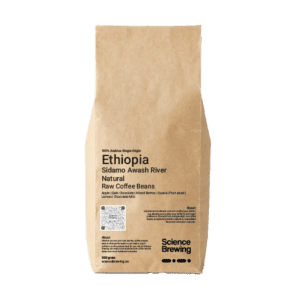
 Ethiopia Sidamo Awash River Natural – Raw coffeePrice range: 6,78 € through 16,23 €
Previous lowest price was 7,19 €.
excl. VAT Price range: 7,19 € through 17,20 €Previous lowest price was 7,19 €.
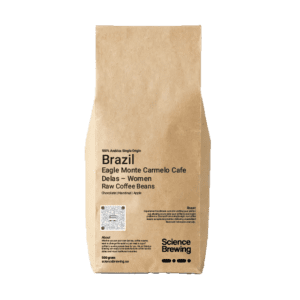
incl. VAT - Brazil Eagle Monte Carmelo Cafe Delas – Women – raw coffeePrice range: 6,35 € through 60,09 € excl. VAT Price range: 6,73 € through 63,70 € incl. VAT
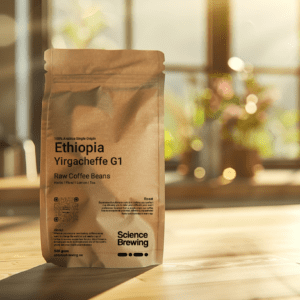
- Ethiopia Yirgacheffe G117,94 € excl. VAT19,02 € incl. VAT