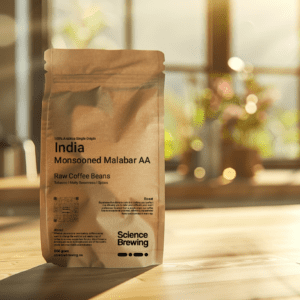
India Monsoon Malabar is one of the world’s most distinctive coffees, known for its low acidity and full-bodied flavor with notes of earth, spice and dark chocolate. In this article, we dive deep into the fascinating process behind this unique coffee, from growing and monsooning to roasting and brewing. We also give tips on how to roast your own Monsoon Malabar at home for the best results.
The story behind Monsoon Malabar
Monsoon Malabar has its roots in the British colonial era in India. In the 17th century, raw coffee was transported from India to Europe in wooden ships, a journey that could take up to six months around the Godahoppsudden. During this long journey, the coffee beans were exposed to humid sea winds and monsoon rains, which caused the beans to swell, fade and develop a unique flavor profile.
When modern transportation methods were introduced in the 20th century, coffee lost this special character. To recreate the desired flavor, a process was developed to deliberately expose the coffee beans to monsoon conditions on land. This process, known as ‘monsooning’, has since become a protected geographical indication under Indian law.

Cultivation of Monsoon Malabar
Before we get into the monsooning process itself, it’s important to understand how and where the coffee is grown. Monsoon Malabar is mainly produced in the states of Karnataka and Kerala along the southwest coast of India, an area known as the Malabar Coast.
Coffee plants thrive in the tropical climate with high altitude, sunny slopes and abundant rainfall. The soils in the region are rich in humus, providing ideal conditions for coffee cultivation. Both Arabica and Robusta varieties are used for Monsoon Malabar, but Arabica is most common and is considered to produce the highest quality.
The Monsooning process: From green coffee to Monsoon Malabar

The monsooning process is at the heart of the creation of Monsoon Malabar. Here is a detailed walk-through of the steps:
- Harvesting and initial processing: The coffee berries are harvested when they are fully ripe. For Monsoon Malabar, naturally processed (dried) coffee beans are usually used.
- Drying: The harvested coffee beans are dried in the sun on large surfaces. This is a critical phase where the moisture content of the beans is reduced to around 11%.
- Grading: After drying, the beans are graded into different quality grades, usually ‘AA’ and ‘A’. More on these grades later in the article.
- Storage: The graded beans are stored in warehouses pending the monsoon season.
- Exposure to monsoon winds: When the monsoon season starts in June, the beans are spread out in 10-15 cm thick layers in specially built storage buildings with good ventilation. These buildings are designed to protect the beans from direct rainfall but allow the moist monsoon winds to circulate freely[1][4].
- Regular stirring: The beans are shaved and turned regularly to ensure even exposure to the moisture. This usually happens several times a week.
- Swelling and color change: During the 12-16 weeks of the process, the beans absorb moisture and swell to almost double their size. At the same time, they fade from their original green color to a pale golden hue.
- Repacking: The beans are repacked at regular intervals to ensure even moisture absorption[4].
- Final sorting: After the monsooning process is completed, a further sorting is done to separate the fully monsoon treated beans.
- Drying and packaging: The beans are gently dried to reach an optimum moisture content of around 14.5% (compared to 10.5% for traditionally processed Indian coffee beans). They are then packaged for export.

This whole process results in coffee beans with unique characteristics:
- Almost double the size compared to untreated beans
- Pale golden color
- High moisture content (around 14.5%)
- Lower density than other coffee beans
- Dramatically changed flavor profile with lower acidity and increased richness
Quality grades: AA and AAA

In the case of Monsoon Malabar and other Indian coffees, the designations AA and AAA are often used to indicate quality. Here is what these grades mean:
AA-grad:
- This is the most common high quality grade for Monsoon Malabar.
- AA beans are large and well formed with few defects.
- They have undergone a complete monsooning process and exhibit the characteristic features of Monsoon Malabar.
AAA-grad:
- This is the highest quality grade and is less common.
- AAA beans are the largest and most perfectly shaped beans.
- They have undergone an optimal monsooning process and are considered to have the best flavor profile.
It is worth noting that these gradings are primarily based on the physical characteristics of the beans and do not necessarily guarantee a superior taste. Many factors, including roasting and brewing, influence the final cup quality.
Roasting Monsoon Malabar at home
For coffee enthusiasts who want to experiment with roasting at home, Monsoon Malabar offers an exciting challenge. Here are some tips to get the best out of your green coffee:
- Start with high-quality green coffee: Make sure you buy fresh AA or AAA grade green coffee from a reliable supplier. Fresh green coffee is essential for best results.
- Be prepared for a longer roasting time: Due to the high moisture content of Monsoon Malabar beans, roasting often takes longer than for other coffees. Expect the roasting process to take 2-3 minutes longer than normal.
- Aim for a darker roast: Monsoon Malabar tends to develop its best flavors in a darker roast. Aim for a full city+ or light French roast to bring out the characteristic earthy and spicy notes.
- Pay attention to the first crack: The first crack may come later than usual due to the high moisture content. Be patient and trust your senses.
- Listen carefully for the second crack: The second crack may be less distinct than for other coffees. Use both audio and visual cues to assess the degree of roasting.
- Experiment with roast profiles: Try different roast profiles to find the one that best brings out the unique characteristics of your Monsoon Malabar. Some people prefer a faster roast to preserve more of the coffee’s original character, while others prefer a slower roast for a more even development of flavors.
- Let the coffee rest: After roasting, let the coffee rest for at least 24-48 hours before grinding and brewing it. This gives time for the gases to evaporate and the flavors to fully develop.
- Experiment with different brewing methods: Monsoon Malabar can give great results in espresso and other brewing methods that emphasize its fullness. Try different methods to find your favorite.
For more information on roasting at home, check out our guide onhome coffee roasting.
Flavor profile and brewing tips
Monsoon Malabar is known for its unique flavor profile that is markedly different from most other coffees. Here are some of the characteristic flavors and properties:
- Low acidity: One of the most prominent characteristics of Monsoon Malabar is its low acidity. This makes it an excellent choice for those who prefer a milder coffee or have a sensitive stomach.
- Full body: The coffee has a heavy, almost creamy body that gives a full mouthfeel.
- Earthy notes: Many describe the flavor as earthy or malty, giving it a distinctive character.
- Spicy notes: Subtle spicy notes are often present, adding to the complexity of the coffee.
- Nutty elements: Many people experience nutty flavors, especially in darker roasts.
- Chocolate notes: Especially in darker roasts, notes of dark chocolate may appear.
- Tobacco-like flavors: Some describe a hint of sweet tobacco in the flavor profile.
To get the most out of your Monsoon Malabar, here are some brewing tips:
- Espresso: Monsoon Malabar makes a great espresso with thick crema and a rich flavor. Try using it as part of your espresso blend to add extra body and complexity.
- French Press: The full body of the Monsoon Malabar is perfectly suited for French Press brewing. For best results, use a coarse grind and let the coffee steep for 4-5 minutes.
- Pour Over: For pour over methods like V60 or Chemex, use a slightly coarser grind than usual and experiment with the amount of water to find the perfect balance.
- Cold Brew: Monsoon Malabar makes an excellent cold brew with its low acidity and fullness. Let it brew for 12-24 hours at room temperature for best results.
- Blends: Monsoon Malabar can be a great addition to coffee blends. Try mixing it with a lighter roasted, more acidic coffee to create a balanced and complex blend.
Sustainability and ethics
As with all coffee production, it is important to consider sustainability and ethical issues when it comes to Monsoon Malabar. Here are some aspects to consider:
- Environmental impact: The monsooning process is relatively low-tech and does not require a lot of energy, which can be seen as an advantage from an environmental point of view. However, it is important to consider the environmental impact of transportation when buying coffee from India.
- Working conditions: Make sure to buy from suppliers that guarantee good working conditions for coffee farmers and workers involved in the monsooning process.
- Certifications: Look for certifications such as Fair Trade, Rainforest Alliance or UTZ to ensure that the coffee was produced under ethical conditions.
- Preserving traditional practices: The monsooning process is a unique part of India’s coffee culture. By buying Monsoon Malabar, you are helping to preserve this traditional method.
- Supporting local communities: Coffee production is an important source of income for many communities in southern India. By buying Monsoon Malabar, you are supporting these communities.
Storage of green coffee and roasted Monsoon Malabar
Proper storage is essential to preserve the quality of your Monsoon Malabar, whether it is raw coffee or roasted. Here are some tips:
Storage of green coffee:
- Store the green coffee in a cool, dry environment.
- Use airtight containers to protect the beans from moisture and odors.
- Avoid direct sunlight and heat.
- Monsoon Malabar green coffee can be stored for up to one year under optimal conditions.
Storage of roasted coffee:
- Store roasted coffee in an airtight container, preferably with a one-way valve.
- Keep coffee away from heat, light and moisture.
- Use roasted Monsoon Malabar within 2-4 weeks for best flavor.
- Avoid storing roasted coffee in the refrigerator or freezer, as this can lead to condensation and impair the taste.
For more detailed tips on coffee storage, see our guide on how to store coffee.
Frequently asked questions about Monsoon Malabar
Q: Is Monsoon Malabar strong coffee?
A: Monsoon Malabar is often perceived as “strong” due to its fullness and low acidity, but the caffeine level is comparable to other Arabica coffees.
Q: Can I use Monsoon Malabar for espresso?
A: Absolutely! Monsoon Malabar is great for espresso, especially in blends where it adds body and complexity.
-
 India Arabica Malabar AA, Monsooned – Green coffeePrice range: 10,74 € through 17,08 € excl. VAT Price range: 11,38 € through 18,11 € incl. VAT