For those who are just starting to roast their own coffee at home, all the technical terms can seem overwhelming. One of the most important parameters to understand is the Rate of Rise (RoR). Let’s dive into this fascinating aspect of coffee roasting, from the basics to the advanced chemistry.
What is Rate of Rise?
Rate of Rise is simply the speed at which the temperature increases during the roasting process, measured in degrees per minute. Think of it like the accelerator pedal in your car – the harder you push, the faster the speed increases. Similarly, RoR affects how quickly your coffee beans heat up.
Why is RoR important?

When roasting green coffee, the beans go through several critical phases:
- Dehydration
- Yellowing phase
- First crack
- Development phase
Each phase requires its own optimal RoR to achieve the desired flavor profile. The development time after first crack is particularly sensitive to RoR changes.
The RoR curve and its importance
A typical RoR curve starts high (15-20°C/min) and gradually decreases through roasting to around 5-10°C/min at first crack. This downward trend is crucial in order to:
- Avoiding rust defects
- Developing complexity in taste
- Ensure even roasting throughout the bean
The scientific explanation
When we delve deeper into the science, we see that RoR directly affects the Maillard reactions that create hundreds of flavor compounds in coffee. These reactions between amino acids and sugars are temperature dependent and are strongly affected by how fast the temperature rises.
Chemical processes and RoR
At the molecular level, RoR controls:
- Caramelization of sugars
- Degradation of chlorogenic acids
- The formation of aroma associations
- Development of oils in the bean
Advanced RoR control
To achieve perfection in your roasting, especially for specialty coffee, you need:
Adapting RoR by origin
- Ethiopian coffee often requires lower RoR
- Brazilian coffee tolerates higher RoR
Adjust for degree of roasting
- Lighter roasts: Higher initial RoR, faster de-escalation
- Darker roasts: More moderate RoR curve throughout the process
Consider bean size and density
- Larger beans require slower RoR
- High-grown beans need more gentle heat rising
Common RoR problems and solutions

Problem 1: RoR crash
When the RoR suddenly drops drastically, often around the first crack, it can lead to flat and underdeveloped flavors.
Solution: Gradually increase the heat input before the first crack to maintain momentum.
Problem 2: RoR flare
A sudden increase in RoR late in roasting can result in burnt flavors.
Solution: Reduce the heat input earlier and more gradually.
Practical tips for RoR control
- Document each roast carefully
- Use a good coffee roaster
- Invest in precision temperature measurement
- Experiment systematically with different RoR profiles
Conclusion
Rate of Rise is more than just a technical parameter – it’s the key to consistently producing high-quality coffee with the desired flavor profile. By understanding and mastering RoR, you’ll take your home-roasted coffee to the next level.
To immerse yourself further, we recommend exploring our articles on different roasting degrees and coffee processing methods.
- Product on sale
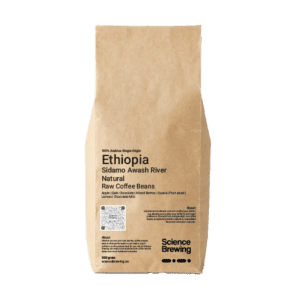
 Ethiopia Sidamo Awash River Natural – Raw coffeePrice range: 6,78 € through 16,23 €
Previous lowest price was 7,19 €.
excl. VAT Price range: 7,19 € through 17,20 €Previous lowest price was 7,19 €.
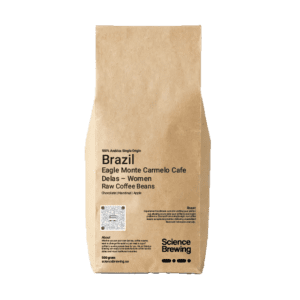
incl. VAT - Brazil Eagle Monte Carmelo Cafe Delas – Women – raw coffeePrice range: 6,35 € through 60,09 € excl. VAT Price range: 6,73 € through 63,70 € incl. VAT
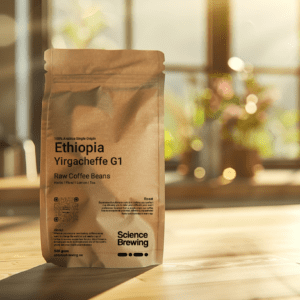
- Ethiopia Yirgacheffe G117,94 € excl. VAT19,02 € incl. VAT